If you’re looking for a trucking company in Brampton, you already know the basics: this city sits at the center of the Greater Toronto Area’s freight corridor. Highway 407, 410, and the Queen Elizabeth Way converge here, putting Brampton-based carriers within a short drive of every major Canada-US border crossing in Ontario: Windsor-Detroit (Ambassador Bridge and Tunnel), Fort Erie-Buffalo (Peace Bridge), and Sarnia-Port Huron (Blue Water Bridge).
That’s why Brampton has one of the highest concentrations of trucking companies in Canada. The question for shippers isn’t whether there’s a trucking company in Brampton that can take your load — it’s how to tell the difference between the 200+ carriers operating out of the same postal code. Here’s what actually separates the reliable ones from the rest.
Trucking company Brampton: asset-based vs. asset-light
The single most important distinction in Brampton’s trucking market is between carriers that own their trucks and carriers that broker loads to owner-operators or subcontractors.
An asset-based trucking company in Brampton owns their tractors, owns their trailers, employs their drivers, and maintains their equipment at their own facility. When you call dispatch, you’re talking to someone who manages the actual fleet that will carry your freight. The carrier’s name is on the truck, their insurance covers the load, and their driver has been vetted, trained, and managed by the same company.
An asset-light carrier — or a broker operating as a carrier — takes your load and subcontracts it to someone else. Sometimes that works fine. But when a border delay happens at midnight, or a reefer throws a code on the 401, or a receiver rejects a load and you need it re-routed immediately, the intermediary between you and the actual truck creates friction that costs time and money.
In 2026, the distinction matters even more. CBSA’s CARM system requires the carrier’s code to be properly linked to the customs entry before the truck arrives at the border. When a broker subcontracts to a carrier you’ve never heard of, the data chain between the importer, the customs broker, and the physical carrier gets complicated. Any mismatch sends the truck to secondary inspection.
Ask the carrier directly: how many trucks do you own? Not “have access to” or “manage” — own. The answer tells you what kind of trucking company in Brampton you’re dealing with.
Fleet size: what the number means and what it doesn’t
A carrier with 10 trucks isn’t necessarily worse than one with 200. Smaller carriers can be responsive, flexible, and personally attentive in ways that larger operations aren’t. But fleet size does determine capacity reliability — especially during peak seasons when every carrier’s trucks are committed.
If you’re running 5-10 loads a week on consistent lanes, a trucking company in Brampton with 200 tractors and 300 trailers can absorb your volume without straining their capacity. A 10-truck carrier covering the same volume has every tractor committed to your freight, which means one breakdown, one driver absence, or one border delay cascades into service failures across your entire shipping schedule.
Fleet composition matters too. A carrier advertising 200 trucks that are all dry vans can’t help you with a reefer load. A carrier with a split fleet — say 150 dry vans and 150 reefers — can handle both, which simplifies your carrier management and keeps all your freight under one dispatch umbrella.
Cross-border certifications: non-negotiable for any trucking company Brampton shippers rely on
Any carrier in Brampton that moves freight to the United States needs to be evaluated on their border certifications. This isn’t optional — it directly affects how fast your freight crosses and how often it gets inspected.
CT-PAT certification means the carrier has been vetted by US Customs and Border Protection and receives preferential treatment in CBP’s targeting system. FAST certification means their drivers carry individual FAST cards and can use dedicated border lanes at the major crossings. PIP (Partners in Protection) is the Canadian equivalent, administered by CBSA. A carrier with all three is pre-cleared on both sides of the border.
SmartWay certification matters for shippers with ESG or Scope 3 emissions reporting requirements. HAZMAT certification opens up regulated freight that most carriers can’t handle. CSA (Customs Self Assessment) streamlines the import process on the Canadian side.
A trucking company in Brampton with six certifications — CT-PAT, FAST, PIP, SmartWay, HAZMAT, CSA — has invested seriously in compliance infrastructure. That investment signals a company that takes the operational side of trucking as seriously as the sales side.
Insurance: check the actual policy, not just the claim
Ontario trucking companies are required to carry insurance, but the coverage levels vary enormously. General liability coverage should be substantial for cross-border operations. Cargo insurance should cover the replacement value of what you’re shipping.
Just as important as the coverage level is who the insurer is. A policy from a major, established insurer is underwritten by a company with the financial capacity to pay a claim. A policy from a small specialty insurer you’ve never heard of might be cheaper for the carrier, but it’s riskier for you if something goes wrong.
Ask for the certificate of insurance. Verify the insurer. Check the expiration date. Any serious trucking company in Brampton will send you their COI within an hour of being asked — they send it dozens of times a month to shippers and receivers who request it.
Warehouse access: the Brampton advantage
One of the operational advantages of working with a Brampton-based carrier is proximity to warehouse and cross-dock facilities. A trucking company in Brampton with their own warehouse on-site can consolidate LTL shipments from multiple shippers into full truckloads, store freight waiting for customs clearance or delivery appointments, and stage cross-border loads so that documentation is complete and verified before the truck is dispatched to the crossing.
This is particularly valuable for LTL shippers who don’t generate full truckload volumes on their own. A Brampton warehouse consolidation operation can combine your pallets with other shippers’ freight, ship the full truck to a US distribution center, and pass the FTL savings on to you.
24/7 dispatch: test it before you need it
Brampton is in the Eastern time zone. Your receivers in California are three hours behind. A delivery appointment in Los Angeles at 6am PST means your dispatch team needs to be coordinating at 3am EST — adjusting for border crossing times, monitoring driver hours, and managing any last-minute changes from the receiver.
Every trucking company in Brampton claims 24/7 dispatch. The way to verify it is simple: call the number at 11pm on a Thursday. If you get a live dispatcher who can answer a question about routing or availability, that’s real. If you get voicemail, that’s a phone system pretending to be a dispatch operation.
Why Alpha Trans is the trucking company Brampton shippers trust
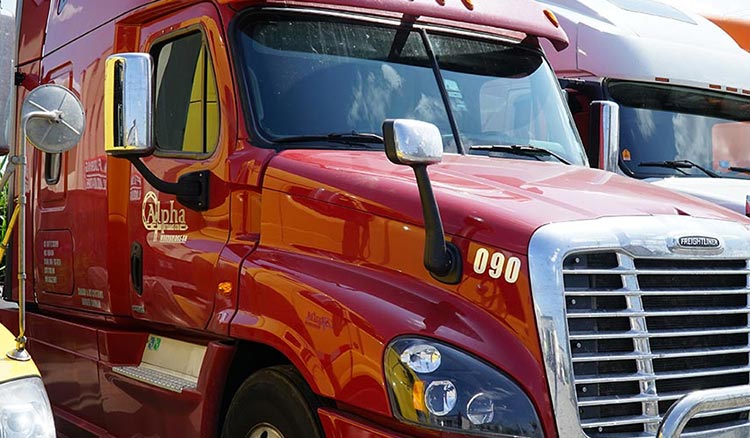
Alpha Trans has been headquartered at 105 East Drive in Brampton since 2002. We operate 200 company-owned tractors and 300 trailers — 150 dry vans and 150 reefers. We’re CT-PAT, FAST, PIP, SmartWay, HAZMAT, and CSA certified, with comprehensive liability and cargo coverage on every load.
Our 20,000 sq ft warehouse handles consolidation, cross-docking, and short-term storage. Our dispatch desk is staffed around the clock — weekends, holidays, and every hour in between. We run daily capacity to California, Texas, Arizona, Illinois, Indiana, Nevada, Oklahoma, Louisiana, Arkansas, and Washington.
If you’re looking for a Brampton-based carrier with real trucks, real drivers, and real border expertise, request a quote or call us at (905) 799-1525.