CT-PAT certification is one of the most misunderstood credentials in cross-border freight. If you’re evaluating carriers for shipments between Canada and the US, you’ve seen “CT-PAT certified” on carrier packets and websites. Most shippers treat it as a checkbox — the carrier either has it or doesn’t. But CT-PAT certification isn’t just a badge. It changes how your freight moves through the border at a mechanical level, and the difference is measurable in hours and dollars.
Here’s what CT-PAT certification actually does, how a carrier earns it, what it costs to maintain, and why it matters more in 2026 than it did five years ago.
What CT-PAT certification is — and what it isn’t
CT-PAT stands for Customs-Trade Partnership Against Terrorism. It’s a voluntary program run by US Customs and Border Protection, launched in November 2001 as a direct response to the September 11 attacks. The premise is straightforward: companies that demonstrate robust supply chain security get treated as lower risk at the border. Lower risk means fewer random inspections, faster release of cargo, and priority processing.
The program has grown from seven initial participants to over 11,400 certified partners. Those partners collectively account for more than half of all cargo by value entering the United States. It’s free to join, but the process is rigorous — and maintaining CT-PAT certification requires ongoing compliance, documentation, and periodic revalidation.
What it is not: a guarantee that your freight won’t be inspected. It’s not a fast pass that eliminates all border delays. And it’s not a license — it can be suspended or revoked if the carrier fails a security audit or has a significant security-related incident.
How CT-PAT certification changes what happens at the border
When a truck approaches a US port of entry, CBP’s Automated Targeting System evaluates the shipment based on dozens of risk factors: the carrier, the importer, the commodity, the origin, the destination, the driver, and a scoring algorithm that weighs all of these against known threat patterns.
Carriers with CT-PAT certification receive a lower risk score in this system. In practical terms, that means the truck is less likely to be pulled for a random examination. When CT-PAT trucks are selected for inspection, they receive front-of-line priority over non-certified shipments. During high-alert periods — when border security is elevated and inspection rates spike — CT-PAT partners are prioritized for processing before other cargo.
For a shipper, the impact is cumulative. One random inspection on one load might only cost you a few hours. But if you’re running five loads a week across the border and your carrier gets pulled regularly because they lack CT-PAT certification, the total hours lost over a quarter add up fast — and so do the detention charges, missed appointments, and disrupted production schedules downstream.
CT-PAT plus FAST: why the combination matters
CT-PAT certification on its own helps at the targeting level — your freight is less likely to be flagged. But the physical cross-border experience is where FAST (Free and Secure Trade) makes the difference.
FAST requires three parties to be enrolled: the carrier (CT-PAT certified), the driver (FAST card holder), and the importer (CT-PAT or PIP member). When all three are in the program, the truck can use dedicated FAST lanes at major crossings. At the Ambassador Bridge between Windsor and Detroit, the Peace Bridge between Fort Erie and Buffalo, or the Blue Water Bridge between Sarnia and Port Huron, the FAST lane during peak hours can save an hour or more of wait time compared to the standard commercial lane.
This is why carriers that hold both CT-PAT certification and FAST — with drivers who carry individual FAST cards — deliver a fundamentally different border-crossing experience than carriers with CT-PAT alone. The targeting benefit reduces inspections. The FAST lane reduces physical wait time. Together, they address the two main causes of border delay.
What it takes to earn and maintain CT-PAT certification
CT-PAT certification isn’t a form you fill out online. The carrier must complete a detailed security profile documenting their supply chain security practices across multiple categories: physical security of facilities, cargo integrity and seal procedures, personnel security and background checks, information technology security, driver vetting and training, and process controls for tracking and monitoring shipments.
After the initial application, CBP conducts a validation visit — an on-site security assessment of the carrier’s facilities and operations. Validators look at everything from perimeter fencing and camera systems to how the carrier handles employee termination access and how they verify the identity of contractors and visitors.
Once certified, the carrier is subject to periodic revalidation. CBP can — and does — show up for unannounced assessments. If a carrier fails to maintain their security standards, their status can be suspended or revoked. A significant security incident (a cargo theft, a breach in the supply chain, a falsified document) can trigger immediate review.
Most small carriers don’t pursue CT-PAT certification because the administrative overhead isn’t worth it for their volume. The ones who carry it tend to be mid-size and larger carriers with dedicated compliance staff and the operational discipline to maintain the standards year over year. That’s part of the signal it sends: a CT-PAT certified carrier takes operational rigor seriously, not just at the border but throughout their operation.
Why CT-PAT certification matters more in 2026
Three regulatory shifts have made CT-PAT certification more operationally significant than it was even two years ago.
First, CBSA’s CARM system is now fully digital. Pre-arrival processing on the Canadian side is strictly electronic — if the data isn’t clean and linked before the truck arrives, the driver gets sent to secondary. Carriers with CT-PAT certification (and its Canadian equivalent, PIP) are already operating within a framework of data discipline and pre-clearance procedures that aligns with CARM’s requirements. Non-certified carriers are more likely to have documentation gaps that trigger holds under the new system.
Second, CBP now requires electronic manifests submitted before arrival, and the targeting algorithms have gotten more sophisticated. The gap between how CT-PAT and non-CT-PAT shipments are treated has widened as the system gets better at scoring risk. Carriers without certification face higher inspection rates, not because they’re doing anything wrong, but because the system treats unknown or unverified carriers more cautiously.
Third, large shippers and OEMs are increasingly requiring CT-PAT certification as a condition of their carrier onboarding. Many automotive and pharmaceutical manufacturers won’t even consider a carrier that isn’t certified. It’s become a prerequisite for accessing the highest-value freight lanes, not just a competitive advantage.
What to ask your carrier about CT-PAT certification
Don’t just ask “are you CT-PAT certified?” Ask these:
When was your last CBP validation visit, and were there any findings? Do your drivers carry individual FAST cards, or just the company? Are you also PIP certified on the Canadian side? What’s your average border-crossing time at Windsor, Fort Erie, and Sarnia? How do you handle a situation where a load is flagged for inspection — do you have a process, or does the driver figure it out?
The answers will tell you whether CT-PAT certification is a real operational commitment for this carrier or just a logo on their website.
Alpha Trans and CT-PAT certification
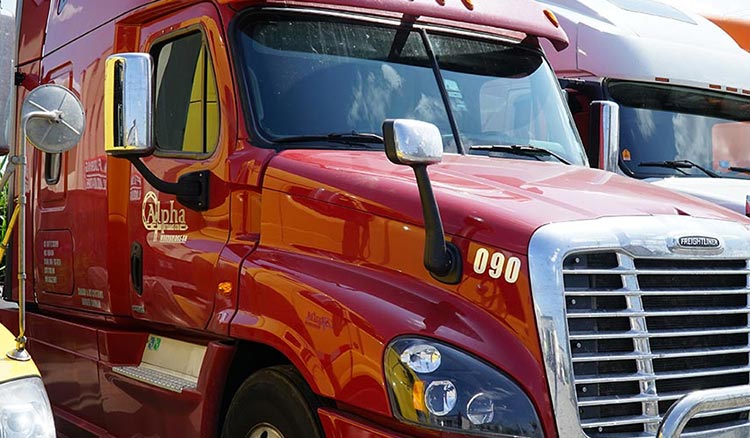
Alpha Trans has maintained CT-PAT certification since the program’s early years. We’re also FAST, PIP, CSA, SmartWay, and HAZMAT certified — six border certifications that very few carriers our size carry simultaneously. Our drivers hold individual FAST cards and use FAST lanes at every major Ontario-US crossing.
We run 200 company-owned tractors across the border daily. Our dispatch team verifies documentation and customs readiness before every load is dispatched to the crossing. When something goes wrong at the border — and eventually something always does — we have a dispatcher on the phone who knows the load, the driver, and the customs broker.
If CT-PAT certification is a requirement for your carrier panel, or if you’re tired of border delays eating into your transit times, request a quote or call us at (905) 799-1525.